
👇 Take this lesson with you! 👇
Using the correct grammar in IELTS Speaking is really important, if you want to get a high score.
Did you know 90% of students make a grammar mistake in their initial responses during the test?
See the top 5 speaking grammar mistakes students make.
This post will guide you through the main grammatical tenses you can use to ace your IELTS Speaking test.
Table of Contents
The big question: Which tense should I use?
The truth is, there’s no ‘correct tense’ you should use for any particular answer. The tense you should use depends on what you want to convey. However, you can generally categorise your responses into three situations:
- Talking about the present
- Talking about the past
- Talking about the future
Let’s look at each of these situations and explore the tenses you can use.

Talking about the present time
When discussing the present, you have a variety of tenses at your disposal. These include:
- Present Simple
- Present Continuous
- Present Perfect Simple
- Present Perfect Continuous
Examples to guide you
Suppose you’re asked in IELTS Speaking Part 1, “Where do you live now?” Here’s how you can answer using different tenses:
- I live in Spain. (Present Simple: Present state now)
- I’m living in Spain at the moment. (Present Continuous: Temporary Situation
- I have lived in Spain for 5 years. (Present Perfect Simple: Ongoing with focus on time; 5 years)
- I have been living in Spain for 5 years.(Present Perfect Continuous: Ongoing with focus on activity; living in Spain)
All these tenses are correct and can be used in various combinations to answer the question effectively.
Model answer
I am living in Spain now, I actually moved here for work reasons. I have been living here for 5 years and I really enjoy it, it’s a great place to live.
Tip: Make it Personal
To ensure you’re actively using this knowledge, whenever you are practicing speaking English tenses, try to make sentences that are true for you.

Talking about past time
When it comes to discussing the past, you can use:
- Past Simple
- Past Continuous
- Past Perfect
- Used to
- Would
Examples to illuminate
If you’re asked about your childhood, last job, or a previous holiday, you can use the following tenses:
- I lived in Manchester when I was (Past Simple)
- I was living in Manchester when I met my girlfriend. (Past Continuous: Overlapping events, good for starting stories in IELTS Speaking Part 2 questions)
- I had actually moved to Manchester 2 years before I met my girlfriend. (Past Perfect: Explaining a reason for past situation)
- I used to live in Manchester. (Used to: No longer true)
- When I lived in Manchester, I would catch the bus every day to school. (Would: Past habits)
Model answer
I met my very first girlfriend about 10 years ago. I was living in London when I met her in a museum. It was pure luck, because I had never been to that museum before. In fact, I never used to go to museums, but I went to that one to see a Van Gogh exposition someone had recommended.
Tip: Change One Word
To activate your knowledge, whenever you are practicing tenses, try changing one word in the phrase to make it true for you

Talking about the future
For future scenarios, you can use:
- Future with Will
- Future with Going to
- Present Continuous
- Might, May, Could
Examples to enlighten
You may be asked about the future in IELTS Speaking Part 3 questions, but it may also come up in part 1. For example, If asked, “Will you change your job in the future?” you can respond with:
- I don’t think I will change my job just yet. It’s not great, but I think it will get better (Future with Will: If you decide now or make a prediction)
- I am not going to change my job just yet. (Future with Going to: Something decided and planned)
- I am starting a new job next week. (Present Continuous: Planned and scheduled)
- I might change my job, if I find a better one. (Modals: Might, May, Could to express future possibility)
Model answer
I don’t think I will change my job just yet. It’s not great, but I think it will get better. In fact, I am going to ask to take on more responsibilities so I can gain more experience. That might help me get a promotion in the future.
Tip: Work on Intonation and Pronunciation
To truly master grammar, practice speaking it out loud and focus on your intonation and pronunciation.

Conclusion
Remember, these tenses are not ones you must use, but ones you can use. The key is to be flexible and adapt your language to what you want to express.
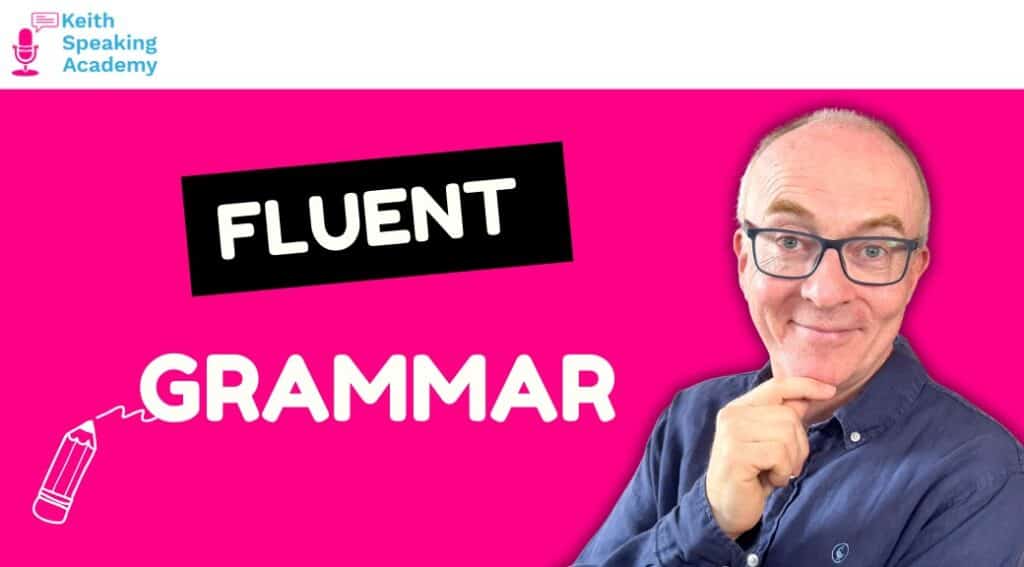
For a more in-depth guide, check out the online course Fluent Grammar for IELTS Speaking. Good luck!
Frequently Asked Questions
Grammar accounts for 25% of your IELTS Speaking band score. Accurate verb tenses, subject-verb agreement, and article usage help ensure your messages are clear and coherent.
Frequent errors include confusing tenses (e.g., “I meet my friend yesterday”), missing agreement in the third person (e.g., “He go”), and misuse of articles (e.g., “I saw movie”).
Record yourself and listen back to catch mistakes. Then focus on one area at a time—like tenses or articles—and practice using correct forms in real responses.
Not necessarily. According to the IELTS Band Descriptors, even a band 8 can have "occassional inappropriate and non-systemaic errors". IELTS examiners also assess fluency, vocabulary, and pronunciation. Strive for accurate use of a mix of simple and complex structures—not perfect grammar alone.
Improve your Speaking Skills with this Free Course
Crack IELTS Speaking Part 1
Learn to Speak with Confidence in Part 1 of Your IELTS Test!
⭐️⭐️⭐️⭐️⭐️
‘It’s such a great course. I’ve learned so many usages for speaking part 1.’
Zu Htet


2 thoughts on “How to Use the Correct Grammar in IELTS Speaking!”
Pingback: 10 Simple Steps to Becoming Fluent in English - Keith Speaking Academy
It is very fruitful for my study