👇 Take this lesson with you! 👇
Table of Contents
When you speak English, do you sound slow, flat or even robotic?
If so, this lesson will help you.
Many students work on improving fluency and intonation with shadowing: listening to a native or fluent speaker and speaking along with them, trying to copy the way they speak.
Shadowing can be a great exercise.
But there’s a problem.
Shadowing asks you to do a lot of things at the same time.
You have to listen, remember the words, pronounce the sounds, follow the rhythm, use the right stress and copy the intonation — all while trying to keep up with the speaker.
That’s difficult!
Instead, I recommend breaking the process down first.
In this Fluency Lab, I’ll show you three simple drills you can use before shadowing:
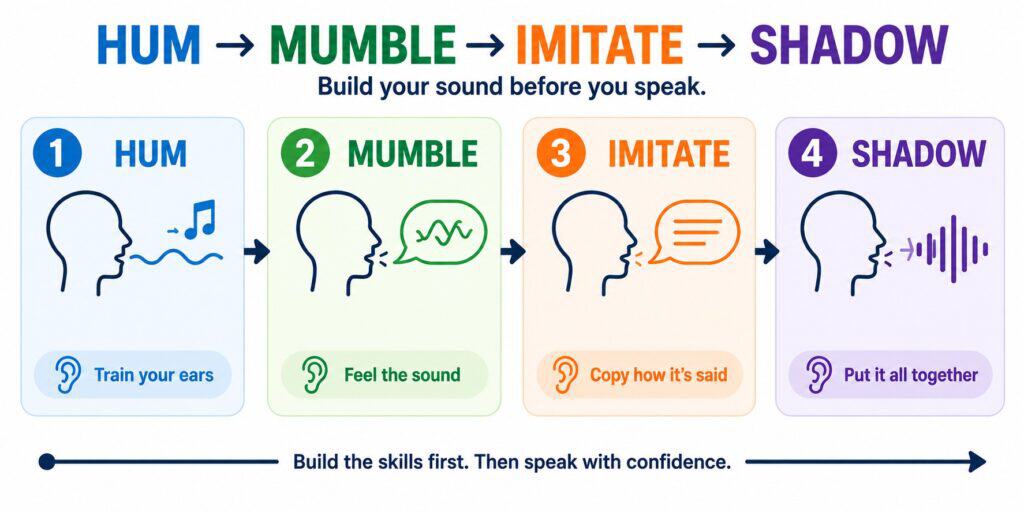
Humming → Mumbling → Imitating → Shadowing
Let’s look at how they work.
What makes spoken English sound natural?
Fluency isn’t just about speaking quickly.
When we speak naturally, three important things are happening:
- Rhythm is the beat and flow of spoken English.
- Stress is the emphasis we give to particular words and syllables.
- Intonation is the way our voice moves up and down as we speak.
Many English learners concentrate so much on choosing the correct words and grammar that these features get less attention.
For example, imagine saying:
Do you fancy going out this weekend?
If every word receives similar stress, the sentence can sound rather flat.
In natural speech, some parts are stronger than others, and the voice moves:
Do you FANcy going OUT this WEEKend? ↗
So how can you train yourself to notice and reproduce this?
Drill #1: Humming
Take a short piece of natural spoken English.
Listen to one phrase or sentence and pause the audio.
Now don’t repeat the words.
Hum the melody instead.
You can hum or use sounds such as da-da-da.
It may feel strange at first, but there’s an important reason for doing this.
When you’re speaking English normally, your brain has lots of work to do. You’re thinking about vocabulary, grammar, pronunciation and meaning.
When you hum, you remove most of that work.
There are no words to remember and no meaning to worry about.
You can focus on the rhythm, stress and melody of the English.
Listen. Pause. Hum.
Keep it simple.

Drill #2: Mumbling
Next, move from humming to mumbling.
To mumble means to speak unclearly, so that the individual words are difficult to hear.
Normally, your English teacher probably doesn’t want you to mumble!
Here, however, we’re doing it deliberately.
Listen to the same short phrase again and pause.
This time, copy the shape and sounds of what you hear. Don’t worry about pronouncing every word clearly.
Why?
Because natural spoken English doesn’t sound like a series of separate words.
Words come together in groups of sound. Some sounds become weaker, words connect, and certain syllables receive more stress than others.
Mumbling helps you feel this without worrying too much about getting every individual word right.
Again, concentrate on the sound rather than the meaning.
Drill #3: Imitating
Now you’re ready to add the real words.
Listen to the same short section, pause the recording and repeat exactly what you hear.
Try to imitate:
- the words and sounds
- the stressed syllables
- the rhythm
- the intonation
At this stage, you’re putting together the things you’ve already practised separately.
You’re no longer just repeating a sentence.
You’re trying to reproduce how the speaker says it.
Afterwards, check that you understand the meaning of what you’ve been saying.
That’s important because intonation isn’t simply decoration. The way we use our voice is connected to what we’re trying to communicate.

Imitating vs shadowing: what's the difference?
These two techniques are similar, but there is an important difference.
- Imitating means:
Listen → Pause → Repeat.
- Shadowing means:
Listen → Speak along just behind the recording without pausing.
That’s why I recommend practising imitation first.
When you imitate, you have time to concentrate carefully on what you’ve heard.
When you shadow, everything happens at once.
Now you're ready to shadow
Once you’ve hummed, mumbled and imitated a short piece of English, play the complete audio again.
This time, don’t pause.
Speak just behind the recording and try to follow the speaker all the way through.
So your complete fluency drill is:
Humming → Mumbling → Imitating → Shadowing
You’re gradually building up the difficulty instead of trying to do everything immediately.
How long should you practise?
You don’t need a long audio recording.
In fact, short is better for this kind of focused practice.
Take a few sentences of natural spoken English and work through them carefully.
Listen several times. Notice the sound. Copy it. Then shadow it.
Five minutes of focused practice can be more useful than spending a long time mechanically repeating English without paying attention to how it sounds.
Don't try to speak faster
There’s one final point I want you to remember.
Fluency isn’t a race.
If you want your spoken English to sound more natural, don’t simply push yourself to speak faster.
Work on the rhythm, stress and intonation of the language.
Train your ears first.
Then train your mouth to reproduce what you hear.
And when you’re ready, put everything together with shadowing.
Practise with the free Fluency Lab workbook
I’ve created a free Fluency Lab: Natural Sound & Rhythm Workbook to help you practise this method.
It includes three everyday speaking situations:
- making plans
- giving an opinion
- agreeing and disagreeing
You’ll practise each one by humming, mumbling, imitating and shadowing, with audio recorded by me and activities to help you notice stress and intonation.
And this is only one part of becoming a more fluent English speaker.
In the next Fluency Lab, we’ll look at continuous speech — how to keep speaking naturally when you need time to think.
FAQs
Yes, it is very good for improving intonation and rhythm. It can be quite challenging, so you can also try humming. mumbling and imitating drills before shadowing. This will be easier and much more effective.
Shadowing means you speak at the same time as the speaker on the audio, without stopping. Imitating means you first listen, then stop the recording, and then repeat what they said. Both are good techniques for speaking practice.
Shadowing is best with short clips. To be effective, you should use short audio clips ranging from around 30 seconds up to 2 minutes. Any longer and you will lose concentration
If you are an upper-intermediate (B2) or advanced student (C1) and you want to improve your fluency praactising English in real conversations with real people, join the Speaking Fluency Club.