👇 Take this lesson with you! 👇
Table of Contents
If you’re preparing for the IELTS Speaking test, or you simply want to sound more natural and confident in English, you’ve probably heard people say: “Use idioms!”
But here’s the thing: idioms are only part of the story. As an IELTS teacher with over 10 year’s experience, today, I’m going to share something really important that I’ve never revealed before — the difference between idioms and idiomatic expressions.
Understanding this could be the key to sounding more fluent, getting Band 7+ in IELTS, and feeling more confident when you speak English.
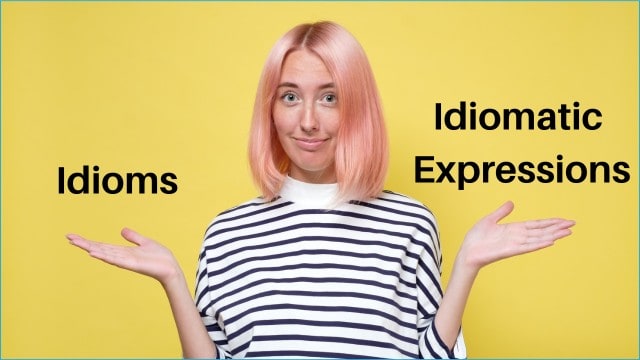
Idioms vs. Idiomatic Expressions: What’s the Difference?
First of all, an expression is “idiomatic” if the meaning of the whole phrase is different from the meaning of the individual words. It doesn’t have a literal meaning. ‘Idiomatic” is also used to refer generally to the language used by native speakers.
Now, think of “idiomatic expressions” as a big umbrella. Under this umbrella, you’ll find:
- Idioms → figurative phrases like “spill the beans” (meaning tell a secret) or “over the moon” (meaning very happy).
- Some Phrasal Verbs → figurative ones like “put off” (meaning delay).
- Some Formulaic Expressions / Chunks → figurative ones like “by the way”, “I’m afraid not”.
- Proverbs, Similes, and Metaphors → everyday cultural or figurative sayings.
👉 Idioms are usually abstract or figurative phrases and often have a cultural reference. They are also often used as full grammatical sentences (subject + verb + object):
She spilled the beans.
👉 Idiomatic expressions are often shorter, to some extent figurative, but usually not full grammatical sentences. They also rarely have a cultural reference.
By the way…
Both are “idiomatic,” because their meanings aren’t literal.
10 Common Idiomatic Expressions You May Know
Here are 10 idiomatic expressions native speakers use every day (and that you can start using too):
- By the way → used to change topic.
By the way, have you finished your homework?
- On another note → used to introduce a new idea.
On another note, how’s your new job?
- At all → used in negatives for emphasis.
I don’t like spicy food at all.
- For good → permanently.
I’ve moved to Spain for good.
- As a matter of fact → to emphasise or contradict.
As a matter of fact, I’m from Manchester.
- For sure → to strongly agree.
We’ll win this match, for sure.
- Fair enough → to accept another person’s view.
Sorry, I can’t make it today.
Fair enough. - For the time being → for now, temporarily.
You can stay here for the time being.
- I’m afraid not → polite way to say no.
Can we meet tomorrow morning?
I’m afraid not. - I see what you mean → to show understanding.
Traffic here is terrible.
Yes, I see what you mean.
Notice how these don’t really have literal meanings — that’s what makes them idiomatic!
Why This Matters for IELTS and Fluency
If you want Band 7, 8, or 9 in IELTS Speaking, you need to show a natural range of vocabulary, including idiomatic expressions.
The problem? In my experience as an IELTS trainer, many students focus only on a handful of memorised idioms like “be on cloud nine” or “a blessing in disguise”.
Examiners often see these as clichés and not a skillful use of language. What most candidates don’t realise is examiners also value smaller, everyday idiomatic chunks — the ones native speakers use all the time.
Using phrases like “for the time being” or “I’m afraid not” can sometimes sound more natural than memorising unusual idioms that are difficult to use in real life.
You absolutely can use idioms, but make sure they are context-sensitive. Make sure you are using them in the right context and in the right way. My online course 150 Idioms for IELTS Speaking will show you exactly how to do that.
When I learned French at school, I focused only on individual words and grammar. Our teacher also made us memorise about 5 common idioms. I didn’t realise that native speakers rely so much more on idiomatic expressions like ‘ça y est’ or ‘pas du tout.’
When I visited France, and started hearing, noticing and repeating these chunks, my speaking became much more natural. The same will happen with you – once you combine using regular idioms with everyday idiomatic expressions, your confidence will skyrocket.
How You Can Learn Idiomatic Expressions
- Listen actively → Notice these expressions in TV shows, podcasts, and conversations.
- Learn them in chunks → Practice saying “by-the-way” as one sound.
- Use them naturally → Try them in your daily conversations, not just in exams.
- Keep a phrase journal → Write down expressions you hear and review them often.

Frequently Asked Questions
Yes, but not just idioms! Examiners want to hear natural, idiomatic language — including everyday expressions like “for sure” or “fair enough.”
No. Idioms are a type of idiomatic expression, but the term “idiomatic expressions” also covers phrasal verbs, lexical chunks, and short figurative phrases.
Listen to conversations, repeat phrases as chunks, and use them in your daily speaking practice.
An idiomatic expression is a phrase where the meaning of the whole phrase is different from the meaning of the individual words. It is often figurative or metaphorical.
An idiom is a kind of idiomatic expression. It is an abstract or figurative phrase and often has a cultural reference. They are often used as full grammatical sentences (subject + verb + object) like “She spilled the beans” meaning "She told a secret".
Improve your Speaking Skills with this Free Course
Crack IELTS Speaking Part 1
Learn to Speak with Confidence in Part 1 of Your IELTS Test!
⭐️⭐️⭐️⭐️⭐️
‘It’s such a great course. I’ve learned so many usages for speaking part 1.’
Zu Htet