
IELTS Speaking Lesson about Daily Routines - Part 2

Table of Contents
Listening Activity: Daily Routines
Listen to this dialogue between two people
1. Who is speaking?
a) Two students
b) A student and a teacher
c) A mother and son
d) A worker and a student
d) A worker and a student
I’m still a student
I work full-time now
My grandma says routines can reduce stress
2. True / False / Not Given
Listen again and decide if the following phrases are true, false or not given.
a) Tom believes routines are always positive.
b) Anna works fixed hours every day.
c) Tom finds studying exciting all the time.
d) Anna thinks routines are useful for children.
e) Both speakers agree routines should be completely avoided.
a) Tom believes study routines are always positive. F
That routine helps me stay on track with my studies.
I think they can be both good and bad.
b) Anna works fixed hours every day. NG
I have a full time job
c) Tom finds studying exciting all the time. F
If I study the same way every day, I feel bored to tears.
d) Anna thinks routines are useful for children. T
I think routines are good for some people, like children.
e) Both speakers agree routines should be completely avoided. F
I think routines are good for some people,
Maybe the best thing is balance—a routine, but with some flexibility.
3. Listen and find phrases similar to these
a) Unable to change your situation
b) Continue moving towards a goal
c) Feeling you are improving step by step
d) Very bored
a) Unable to change your situation
- Stuck in a rut
b) Continue moving towards a goal
- Stay on track
c) Feeling you are improving step by step
- A sense of progress
d) Very bored
- bored to tears
4. Listen again and follow the script below
Anna: Hi, Tom, how are you doing?
Tom: Not bad – same old, same old!
Anna: Yeah, I know what you mean, sometimes I feel like I’m stuck in a rut. I was reading an article the other day about the benefits of routines. What do you think? Do you think routines are a good thing?
Tom: Hmm, I think they can be both good and bad. I’m still a student, so I try to follow a daily routine at uni. I tend to go to the library most mornings, I’ll have lectures in the afternoon, and I typically review my notes in the evenings. That routine helps me stay on track with my studies.
Anna: That makes sense. I work full-time now, and you know what? Although routines can be boring, they help me be more productive. More often than not, I work on my projects first thing in the morning and then only do emails after lunch. It gives me a sense of progress.
Tom: Exactly. And repetition helps too. I mean, perfection comes through repetition, right?
Anna: True, but don’t you ever feel bored? Sometimes my routine feels so monotonous.
Tom: Yeah, I get that. If I study the same way every day, I feel bored to tears.
Anna: I think routines are good for some people, like children. They give a sense of safety and clear boundaries.
Tom: And maybe for older people too. My grandma says routines can reduce stress and give her a sense of certainty.
Anna: Sure, but for me, I need some variety. Otherwise, life feels a bit dull.
Tom: I know what you mean. Maybe the best thing is balance—a routine, but with some flexibility.

IELTS Speaking Vocabulary: Daily Routines
ALWAYS
I get up early everyday
I will get up early (present habit)
I always get up early
USUALLY
I tend to get up early
I typically get up early
I usually get up early
More often than not, I get up early
RARELY
I rarely get up early
I hardly ever get up early
I get up early once in a blue moon
👉 TIP
If the adverb of frequency is one word it usually goes between the subject (e.g. I, he, you…) and the verb.
I often get up late
I always have coffee in the morning.
If the adverb of frequency is more than one word it usually goes at the beginning or end of a phrase, not in the middle!
I get up at 7am on a regular basis.
From time to time I get up at 9 am.
I go to work every Monday without fail.
Other Adverbs of Frequency
| Always | Usually | Often | Sometimes |
|---|---|---|---|
| Invariably | Typically | On a regular basis | From time to time |
| Without fail | Generally | Frequently | Now and again |
| Without exception | Regularly | Repeatedly | Occasionally |
| Day in day out | Mostly | Time and again | Once in a while |
Tell me about a habit you have and how often you do it!
Idioms to talk about ROUTINES
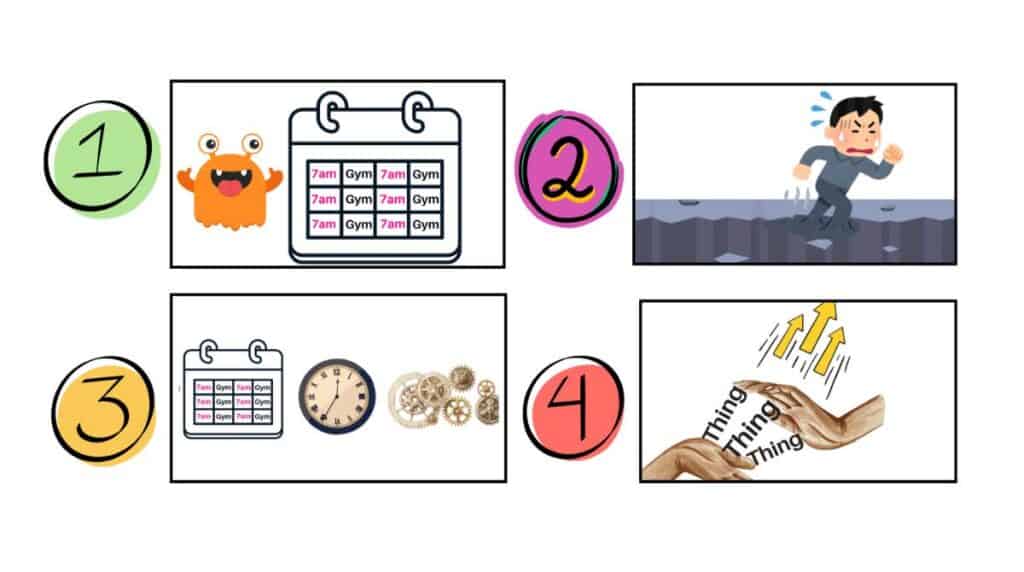
1. To be a creature of habit routine (positive) = someone who likes to have the same
I hate to miss my early morning walk, I am a creature of habit.
2. To be stuck in a rut = doing the same boring routine and not changing (negative)
I feel stuck in a rut with my daily routine.
I have got stuck in a rut at work. I think I need a new job!
3. As regular as clockwork (adv.) = very regularly and predictably
I brush my teeth every morning, as regular as clockwork
Related idiom
- To run like clockwork = to go smoothly and efficiently all the time
4. To shake things up = change your routine to make life more exciting
I travel at weekends to shake things up.
Once in a while, I work in a coffee shop, to shake things up.
Website Recommendation

Song
Verse 1
My dad had a classic saloon,
We’d take long trips in June,
Round every corner, every bend,
I’d get carsick in the end.
I followed in his footsteps too,
Bought a manual, brand new,
I change gears on my own,
That feeling takes me home
Chorus
I wanna hit the road, drive away,
Leave the traffic jams today,
Bumper to bumper, everyday
Driving me up the wall today!
Verse 2
My partner drives an electric car,
A convertible, but it can’t go far,
She says it’s quiet, clean and smart,
But it doesn’t win my heart.
A hatchback, coupe or SUV,
They all look the same to me,
A sports car sits so low and fast,
But I’d rather make the journey last.
Chorus
I wanna hit the road, drive away,
Leave the traffic jams today,
Bumper to bumper, everyday
Driving me up the wall today!
Bridge
No parking spaces anywhere,
Double parking? I wouldn’t dare,
Stuck in traffic, feeling blue,
Tell me, what would you do?
Chorus
I wanna hit the road, drive away,
Leave the traffic jams today,
Bumper to bumper, everyday
Driving me up the wall today!
Language note:
To give someone the sack = to fire them (so they lose their job)
Activate all the vocabulary in this lesson with The Vocabulary Vault!
More IELTS Speaking Free Lessons
If you liked this lesson about music in IELTS Speaking, leave a comment below!
There are more lessons you can follow in the links below too.
FAMILY in IELTS Speaking. How to talk about your family, stages of life, as well as idioms about family.
PERSONAL FINANCE in IELTS Speaking. Idioms and vocabulary to learn how to manage your personal finance, earning, and saving money.
NOISE POLLUTION in IELTS Speaking. How to talk about different types of noise, and how noise pollution affects our lives today.
AMBITION in IELTS Speaking. Vocabulary and ideas to talk about ambitions, as well as some model answers.