Many students preparing for IELTS Speaking make the same mistake.
They try too hard to sound formal.
They learn advanced vocabulary, memorise academic phrases, and use language that sounds more suitable for an IELTS Writing essay than a real conversation.
Examiners want to hear natural, fluent English that sounds like something a real person would say in everyday conversation.
In this lesson, you’ll learn how to convert formal, written English into natural spoken English that will help you sound more confident and improve your IELTS Speaking performance.
Example 1:
Formal Written English
First and foremost, children in schools should be taught about financial literacy.
Natural Spoken English
To begin with, we should teach children about finance when they are at school.
Notice two important changes.
First, the connector becomes more conversational:
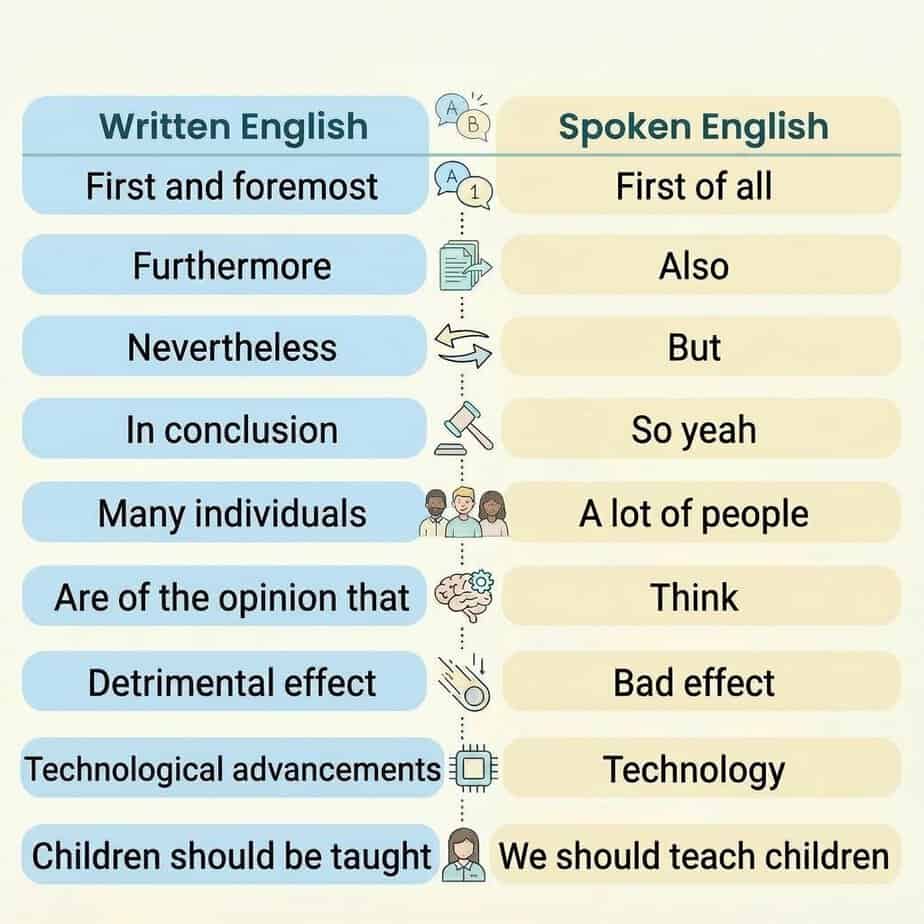
First and foremost → To begin with
First and foremost → First of all
First and foremost → Firstly
Second, the sentence changes from passive to active:
Children should be taught…
We should teach children…
Passive structures are common in writing, while active structures are more common in speech.
Example 2: Formal Opinions
Formal Written English
Many individuals are of the opinion that social media has a detrimental effect on society.
Natural Spoken English
A lot of people think social media is bad for society.
Native speakers usually choose shorter and more direct language when speaking.
Compare:
Many individuals → A lot of people
Are of the opinion that → Think
Detrimental effect → Bad effect / bad for society
When speaking, simplicity often sounds more natural than complexity.
Example 3: Relative Clauses
Formal Written English
The restaurant which opened near my home last year has become extremely popular.
Natural Spoken English
There’s a restaurant near me. It opened last year and now it’s really popular.
Written English often packs lots of information into a single sentence using relative clauses.
Spoken English often breaks information into shorter chunks.
This helps speakers think more easily and sounds more natural in conversation.
Example 4: Academic Vocabulary
Formal Written English
Furthermore, technological advancements have significantly altered the way people communicate.
Natural Spoken English
Also, technology has really changed how people communicate.
Notice the changes:
Furthermore → Also
Technological advancements → Technology
Significantly altered → Really changed
The spoken version is shorter, clearer, and easier to deliver fluently.
Example 5: Formal Conclusions
Formal Written English
In conclusion, it is evident that exercise plays a crucial role in maintaining good health.
Natural Spoken English
So yeah, I think exercise is really important for staying healthy.
Again, the language becomes more conversational.
Instead of saying:
In conclusion
It is evident that
Plays a crucial role in
Native speakers are more likely to say:
So yeah
I think
Is really important for
Quick Comparison Chart
Why Do Students Make This Mistake?
Many learners spend years studying English through textbooks, academic articles, and exam preparation materials.
As a result, they often learn English that is designed for writing rather than speaking.
This becomes a problem in IELTS Speaking because students end up sounding like they are reading an essay instead of having a conversation.
Examiners generally reward candidates who can communicate naturally, flexibly, and fluently.
How to Sound More Natural in IELTS Speaking
1. Stop Writing Your Answers
Many students write complete answers and then try to memorise them.
Instead, practise thinking and speaking spontaneously.
Remember:
Don’t write your answers. Speak your answers.
2. Listen to More Natural English
Good sources include:
Interviews
Podcasts
Chat shows
Panel shows
Drama series
Pay attention to how people really speak.
3. Use Shorter Sentences
Written English often combines ideas into one long sentence.
Spoken English usually breaks ideas into smaller pieces.
This makes communication easier and more natural.
Final Thoughts
Using advanced vocabulary is not necessarily a problem.
The real issue is using language that sounds written rather than spoken.
If you want a higher IELTS Speaking score, focus on sounding natural, conversational, and comfortable.
Remember:
Your goal is not to sound like a textbook.
Your goal is to sound like a confident English speaker.
Not necessarily. Formal English is not wrong, but using too much academic or essay-style language can make your answers sound unnatural. IELTS examiners want to hear fluent, natural communication.
Yes, but only if it comes naturally. A Band 7 or Band 8 candidate uses a range of vocabulary appropriately, not simply the most complicated words possible.
Many learners study English through textbooks and writing exercises. As a result, they often use written English patterns when speaking. Listening to more natural conversations and practising spontaneous speaking can help.
They are used, but generally less often than in writing. In conversation, native speakers frequently break information into shorter sentences rather than packing everything into one complex sentence.
Focus on everyday vocabulary, shorter sentences, natural connectors such as "also" and "but," and active sentence structures. Most importantly, practise speaking rather than memorising written answers.
Keith O’Hare, English teacher and founder of Keith Speaking Academy. Trinity Diploma in TESOL and an MSc in Digital Education (UK).
Over 40,000 learners have taken his online courses.