👇 Take this lesson with you! 👇
Table of Contents
Good conversational English
Examiners assess one thing above all: good conversational English.
Your ideas aren’t graded. You won’t get a higher band for a unique opinion.
Your communication skills aren’t graded either. Whilst eye contact, a clear voice, and confidence may help you, but they don’t directly add points.
What is evaluated are the four official criteria:
- Fluency & Coherence
- Lexical Resource (Vocabulary)
- Grammatical Range & Accuracy
- Pronunciation
Remember, your English performance is graded across the four criteria throughout Parts 1, 2 and 3.
Below, I’ll break these down with clear examples and some tips on how to improve each one so you can get a higher score in the IELTS Speaking test.
Fluency & Coherence
This is how smoothly and logically you speak. A Band 7 speaker “speaks at length without noticeable effort.” In practice, this means you need to:
- Keep going without long pauses or fillers (“err”) dominating your speech.
- Be coherent: organise your ideas logically and use linking phrases.
Useful linking phrases
- As I mentioned before…
- On top of that, I’d add…
- To be honest… / In my view…
- For example… / That said…
- To sum up…
Try developing your answer with the ORJS framework:
- Opinion → Reason → Justify (example/evidence) → Summarise
Do you think public transport should be free?
Opinion: Personally, yes.
Reason: It would reduce traffic. There’d be fewer cars on the road.
Justify: For instance, after my city added free buses on the weekends, congestion fell.
Summarise: So overall, it’s a practical way to reduce traffic and also cut pollution
Practice tip: Record a 60–90 second answer. Check: Did you keep going? Did you link ideas? Did you give a reason + example?

Lexical Resource
This is the range of vocabulary you use and how accurately and appropriately you use it. Examiners look for topic-related and context-sensitive vocabulary used accurately.
For example, here is some topic-related vocabulary you could be using to talk about The environment
- carbon neutral, carbon footprint, global warming, rising sea levels, renewable energy.
Do:
- Use a mix of common and less-common vocabulary naturally.
- Use collocations correctly (e.g., reduce your carbon footprint, renewable energy sources).
- Be mindful of style and nuance (formal vs informal) suitable for the question.
Don’t:
- Force idioms you’re not 100% confident with. Misusing idioms can hurt your score.
Range vs Accuracy—find the balance
Think of two sliders you move together:
- Range: new/precise words for the topic
- Accuracy: correct meaning, collocations, and register
If you push “range” up but “accuracy” down (misused words/idioms), your score suffers. Aim for a balanced rise in both.
👉 Boost your vocabulary across 20 common IELTS Speaking topics with the Vocabulary Vault.
Grammatical Range & Accuracy
You need both simple and complex grammar—used accurately.
- My brother lives in Manchester.
(SVO clause, present simple)
- My brother, who lives in Manchester, has lived there for about ten years now and is thinking of moving somewhere else.
(relative clause + present perfect + coordinating conjunction + present continuous)
How to “activate” your grammar
- When you plan and practise answers, build the sentence: start simple, then add a clause, a connector, a time phrase, a contrast, etc.
- Practise “upgrade drills”: say a basic sentence, then add a reason (because…), a result (so…), a contrast (however…), and a time marker (lately / for the last X years).
Whenever you study grammar, make sure you are also practising speaking it out aloud.
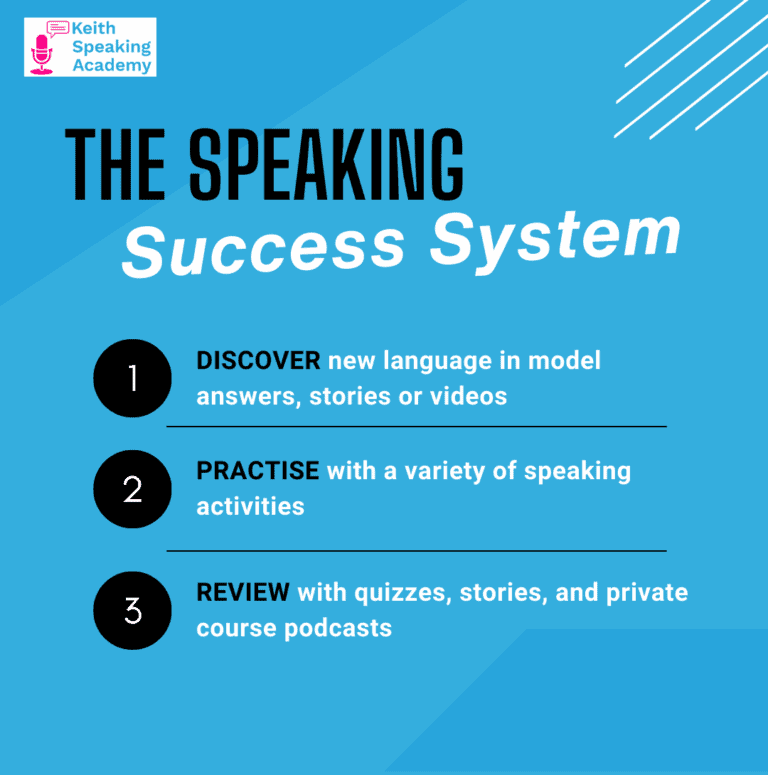
If you’ve been learning with me for a while, you will be familiar with my method to build your speaking skills, including activating grammar. It’s a simple three-step method I can the Speaking Success System; Discover → Practise → Review.
Pronunciation
IELTS does not penalise accents. What matters is intelligibility.
Focus on these key pronunciation features:
- Basic sounds (phonemes): /ɪ/ vs /iː/ (ship/sheep), /θ/ vs /s/ (think/sink)
- Word stress: PHOtograph vs phoTOgraphy
- Sentence stress: emphasise key content words
- Connected speech: contractions, linking sounds
- Intonation patterns: such as rising/falling tones for meaning and attitude
- Rhythm: English is largely stress-timed—keep the beat of stressed syllables
Final tips for test day
- Research ideas for common topics (work, study, environment, technology, travel).
- Build your overall spoken English with regular, deliberate practice.
- Follow Discover → Practise → Review each week.
- Do mock tests under timed conditions.
- Stay focused and take your time—you can pause briefly to think.
- Imagine the test is a friendly conversation at an office party.
- Enjoy the test—confidence grows when you practise consistently.
FAQs (People Also Ask)
No. Your ideas help you speak, but only your spoken English is assessed. The IELTS examiners will evaluate the 4 areas of fluency, vocabulary, grammar and pronunciation.
Your accent isn’t scored. What is important is clarity and being easy to understand. More important than accent is having a good control of the English pronunciation features. These include, appropriate word stress, connected speech, rhythm, and natural intonation.
Only if you use them naturally and correctly. Misused idioms that are not context-specific or appropriately used will affect your accuracy and can lower your score.
Yes—sometimes to manage time or move you on. It’s normal and not a negative signal.
No. You need to use a mix of simple and complex grammar. This is how we speak naturally. Remember also that accuracy is as important as range.
Each criterion (Fluency & Coherence, Vocabulary, Grammar, and Pronunciation) gets a band score from 1 to 9. The final score is the average of the four.
Improve your Speaking Skills with this Free Course
Crack IELTS Speaking Part 1
Learn to Speak with Confidence in Part 1 of Your IELTS Test!
⭐️⭐️⭐️⭐️⭐️
‘It’s such a great course. I’ve learned so many usages for speaking part 1.’
Zu Htet