👇 Take this lesson with you! 👇
Table of Contents
Is the IELTS Speaking test nerve-wracking, exciting, challenging, or fun? The truth is—it depends on you. In this post, I’ll walk you through the format of the IELTS Speaking test, what examiners are looking for, and share tips to help you prepare with confidence.
What Is the IELTS Speaking Test?
The IELTS Speaking test is part of the International English Language Testing System, used worldwide to assess your English level if you want to study, work, or live abroad.
👉 Key fact: The Speaking test is the same for both Academic and General Training IELTS.
It is designed to test your natural spoken English, not formal speeches or academic presentations. That means your goal is to show you can handle everyday conversations confidently and clearly.
The IELTS Speaking Test Format
The test lasts 11–14 minutes and has three parts:
Part 1: Introduction & Personal Questions (4–5 minutes)
💡 Tip: Don’t give one-word answers. Show your range of language even in simple questions.

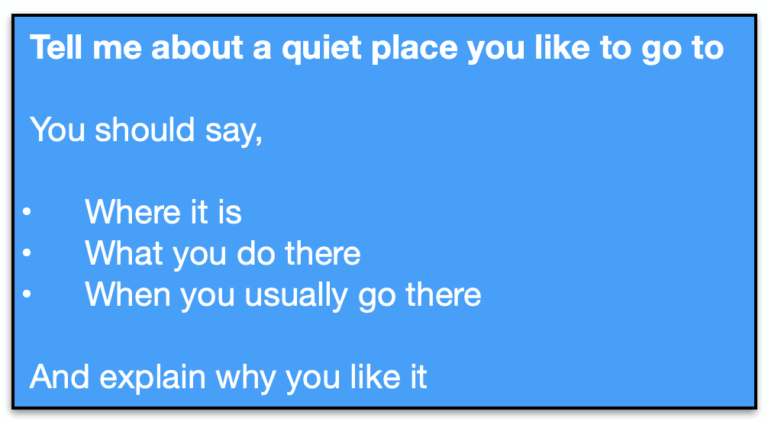
Part 2: The Long Turn (3–4 minutes)
You’ll get a cue card with a topic (e.g. describe a place, a person, a thing, an event, or an experience)
- You have 1 minute to prepare with notes.
- Then you must speak for 1–2 minutes.
- The examiner may ask a follow-up question.
💡 Tip: Use the bullet points as a guide, but focus on telling your story. Practice speaking for 2 minutes. Do this by building up from 20 seconds → 40 → 60 → 120 seconds.
Part 3 – Deeper Discussion (4–5 minutes)
The examiner will ask abstract or opinion-based questions connected to Part 2.
For example: if Part 2 was about something you bought, Part 3 could explore online shopping, consumer safety, or differences between men and women when they go shopping.
💡 Tip: Give longer answers. Share your opinion, justify it, give examples if possible to develop your answer.

What Examiners Are Looking For
Examiners use four criteria (each worth 25%):
- Fluency and Coherence – Can you speak smoothly, connect ideas, and develop answers without too much hesitation?
- Lexical Resource (Vocabulary) – Do you use a wide range of words naturally and accurately? Simple words are fine if they are the right words to convey what you mean. You will probably need to mix common and lesson common vocabulary. To get a band 7 or above, you will also need to use idiomatic language successfully.
- Grammatical Range and Accuracy – Can you mix simple and complex sentences? Are you mostly accurate?
- Pronunciation – Are you clear and easy to understand? Do you use word stress, sentence stress, connected speech, and intonation naturally?
👉 Good news: You don’t need a British or American accent. A clear local accent is fine as long as it doesn’t affect understanding.
Tips to Prepare for the IELTS Speaking Test
✅ Focus on conversational English – practise natural speech, not memorised speeches.
✅ Get ideas on common topics (family, work, environment, technology, shopping, etc.). This helps you answer Part 2 and Part 3 questions confidently.
✅ Don’t memorise answers – examiners can tell. Practice flexibility instead.
✅ Answer differently each time you practice to build confidence.
✅ Rest well before test day. Any last minute cramming is not going to help you. Test day is a long day, you will need a clear mind to stay focussed.
✅ On test day, surround yourself with English by listening to music, reading short texts, or chatting in English to “warm up.” Choose something that will also relax you.
✅ Adopt a positive mindset. Everyone gets a little nervous and that is normal. Just let you nerves be and decide to enjoy the test. That way, you’ll perform better.
Final Thoughts
So, is the IELTS Speaking test terrifying or enjoyable? Honestly, it’s up to you. With the right preparation and mindset, it can be a chance to show off your English skills and even enjoy a natural conversation.
Remember: most examiners want you to succeed. They’re not your enemy. Believe in yourself, communicate with confidence, and do your best.
I believe you are going to do a great job!
Frequently Asked Questions
It lasts 11–14 minutes, including all three parts.
No, it’s mainly a question–answer format. The examiner asks, you answer.
No. A clear local accent is fine. What matters is pronunciation features like stress, intonation, and clarity.
Yes. The examiner does not check if your answers are true, only your English.
Train yourself to speak for 1 to 2 minutes by gradually increasing your speaking time when you practise answering different cue cards.
Improve your Speaking Skills with this Free Course
Crack IELTS Speaking Part 1
Learn to Speak with Confidence in Part 1 of Your IELTS Test!
⭐️⭐️⭐️⭐️⭐️
‘It’s such a great course. I’ve learned so many usages for speaking part 1.’
Zu Htet