👇 Take this lesson with you! 👇
Table of Contents
Many students memorise English idioms like “to be over the moon” or “I was on cloud nine”— but IELTS examiners have heard those a thousand times.
What kind of idioms do native English speakers actually use every day and how can you use them naturally in the IELTS Speaking test?
In this post, you’ll learn 10 real, modern idioms used by native speakers — and how to use them naturally in Part 1, Part 2, and Part 3 of the IELTS Speaking test.
To grab a bite (to eat)
Meaning: to get something to eat quickly
Everyday use:
Let’s grab a bite before the movie.
IELTS use:
- Part 1 (Food): “If I get up late, I’ll grab a bite at a coffee shop on the way to work.”
- Part 2 (Describe a time you were in a rush): “I grabbed a bite at a small Italian restaurant.”
- Part 3 (Eating habits): “Nowadays, people often grab a bite instead of cooking at home.”

To be broke
Meaning: to have no money
Everyday use:
I can’t go out to the pub, I’m broke.
IELTS use:
- Part 1 (Money): “When I was a student, I was often broke.”
- Part 2 (Describe a difficult time): “After losing my job, I was totally broke.”
- Part 3 (Finance and youth): “Many young people are broke because of high living costs.”
To pick holes (in something)
Meaning: to find small mistakes or weaknesses in something (often unfairly or critically)
Everyday use:
He loves picking holes in everything I say.
IELTS use:
To be under the weather
Meaning: to feel slightly ill
Everyday use:
I’m a bit under the weather today.
IELTS use:

To be swamped
Meaning: to be extremely busy (even more than “snowed under”)
Everyday use:
I’ve been swamped with emails all day.
IELTS use:
✅ Tip: Use this when discussing deadlines, workload and stress. Great for topics about work and study.
To make up your mind
Meaning: to decide
Everyday use:
I can’t make up my mind what to wear.
IELTS use:
- Part 1 (Decisions): “I’m terrible at making up my mind.”
- Part 2 (Describe a difficult decision): “I had to make up my mind about changing jobs.”
- Part 3 (Decision-making): “People take time to make up their minds about major life choices.”

To be in hot water / to get into hot water
Meaning: to be in trouble or face problems (often punished or criticised)
Everyday use:
He’s in hot water for missing the deadline.
IELTS use:
- Part 1 (Work / school): “I was in hot water once for being late.”
- Part 2 (Describe a difficult situation): “I got into hot water when I forgot to submit my assignment.”
- Part 3 (Society): “Politicians often get into hot water for saying the wrong thing.”
To be up in the air
Meaning: uncertain; not yet decided
Everyday use:
Our travel plans are still up in the air.
IELTS use:
- Part 1 (Plans): “My weekend plans are up in the air right now.”
- Part 2 (Describe future plans): “I’m thinking about moving abroad, but it’s still up in the air.”
- Part 3 (Decision-making / economy): “Many people’s career plans are up in the air because of the economy.”
To keep your chin up
Meaning: to stay positive in a difficult situation
Everyday use:
Things will get better — keep your chin up.
IELTS use:
- Part 1 (Difficulties): “Even when I fail, I try to keep my chin up.”
- Part 2 (Describe a challenge): “My family encouraged me to keep my chin up when I lost my job.”
- Part 3 (Resilience): “It’s important for people to keep their chin up in tough times.”

To touch base (with someone)
Meaning: to make brief contact with someone to update or check on something
Everyday use:
Let’s touch base next week to finalise the plan.
IELTS use:
- Part 1 (Friends / Communication): “I live away from home but I try to touch base with my family at least once a week.”
- Part 2 (Describe a work or study project): “I had to touch base with my manager to confirm the details.”
- Part 3 (Workplace / Collaboration): “In business, it’s important to touch base regularly so everyone stays on track.”
✅ Tip: Perfect when describing keeping in contact, checking progress, or coordinating with others — informal yet professional.
Final Thoughts
Idioms like these are simple, natural, and actually used by native speakers — not the over-used ones you often find online.
Practise them lots until you can use them naturally in your IELTS answers to sound confident, fluent, and authentic. In the test, only use ones you are confident with using, and you’ll impress the examiner without sounding memorised.
FAQs
The best idioms for IELTS Speaking are natural, modern expressions that native speakers actually use in daily life.
Examples include to grab a bite, to be swamped, to keep your chin up, to make up your mind, and to touch base.
Avoid outdated idioms like “it’s raining cats and dogs” — they sound memorised and unnatural.
Instead, use idioms that fit the context of your answer story so they sound fluent and authentic.
Yes — but use them naturally and sparingly.
Examiners don’t give extra points just for idioms; they reward natural, fluent communication. Your idioms should match the context of your answer and give the exact meaning you intend.
Forcing idioms into every answer can sound rehearsed and will have a negative effect.
Focus on clear communication.
Remember, idioms are a bonus, not the main goal.
Don’t memorise long lists! Instead, learn idioms in context:
- 📖 Read short stories or articles that include idioms.
- 🎧 Listen to podcasts or watch YouTube videos (like Keith Speaking Academy) where idioms appear naturally.
- 🗣 Use them in your own examples or IELTS Speaking practice.
Finally, review them regularly with songs, stories, or dialogues — that’s how idioms become part of your active vocabulary.
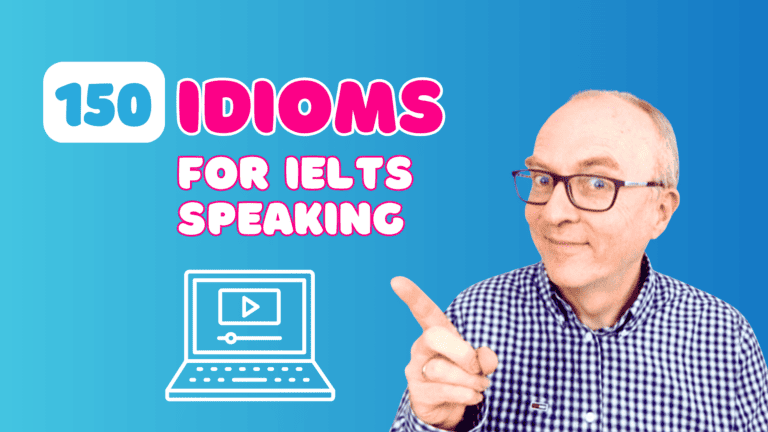
Ready to Master 150 Real English Idioms?
If you enjoyed these 10 real idioms, you’re going to love my 150 Idioms Course — designed especially for IELTS learners who want to sound natural, confident, and fluent in everyday English.
In this course, you’ll:
✅ Learn 150 useful idioms used by native speakers in real conversations
✅ Understand their meaning, pronunciation, and context
✅ Hear examples in stories and dialogues so you can use them naturally
Whether you’re preparing for IELTS or simply want to express yourself more naturally, this course will help you go beyond memorising phrases — you’ll start thinking in idioms!
👉 Join the 150 Idioms Course here and start speaking English like a native — confidently, clearly, and naturally.