IELTS Speaking Part 2

Table of Contents
Last updated: April 2026

Keith O'Hare
Keith O’Hare, English teacher and founder of Keith Speaking Academy. Trinity Diploma in TESOL and an MSc in Digital Education (UK).
Over 40,000 learners have taken his online courses.
Why is Part 2 important?
Part 2 is often known as the ‘Long Turn’. This is a really important part of the Speaking Test. It’s where many candidates do badly and lose their confidence and so also go on to struggle in Part 3.
You need to be well prepared because this is the first chance in the test for you to
- talk over a long period of time without interruptions
- show that you can develop a topic
- show you can speak fluently over longer sentences
What happens in IELTS Speaking Part 2
In Part 2 of the IELTS Speaking Test you are given,
- a topic card
- a pen and paper to make notes
- 1 minute to prepare your talk
The topic card will have 3 or 4 bullet points to guide your talk.
You do not have to follow all of these bullet points, they are just a guide.
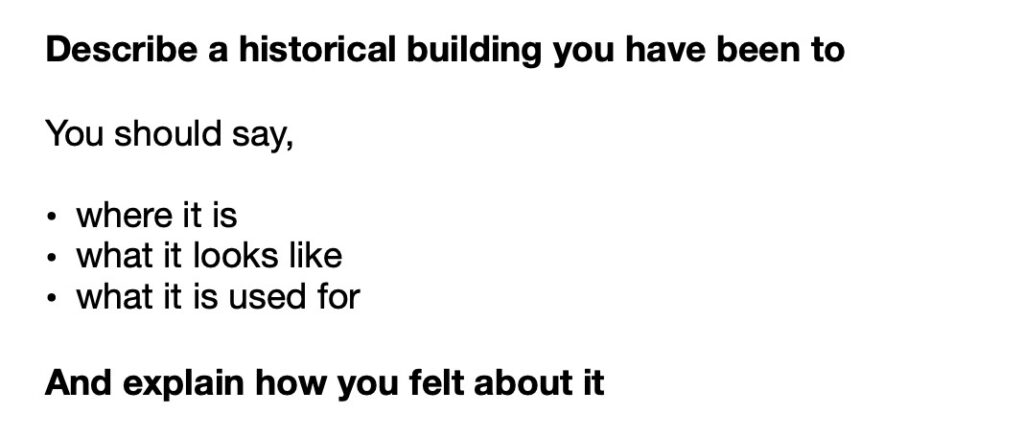
The ‘Topic Card’, sometimes called a ‘Cue Card’, looks like the one below.
The topic will vary, but the format is always the same.
Sample Part 2 Cue Card or Topic Card
Watch this video to see a sample answer for the Part 2 Question above
How long is IELTS Speaking Part 2 (Timing and Task Breakdown)?
IELTS Speaking Part 2 lasts 3 to 4 minutes.
This includes
- 1 minute to prepare your talk.
- 1 to 2 minutes to talk about the topic.
- Up to 1 minute to answer a possible follow-up question.
You don’t have to use the whole 1 minute, but I advise you to do, so you are well prepared.
I recommend you talk for at least 1 minute and 30 seconds.
You can carry on speaking for 2 minutes, but if you stop after 1 minute and 30 seconds, the examiner will ask you a short follow up answer. Either way, the examiner will stop you speaking after 2 minutes.
You will be given paper and pencil to make notes. You can keep both the task card (cue card) and your notes to look at throughout your talk. You only give them back after you have finished your Part 2 talk.
How to use the 1 minute preparation time
Get your idea quickly
- The 1 minute preparation time in Part 2 of the IELTS Speaking test will go by very quickly.
- Don’t waste time brainstorming lots of possible ideas to talk about!
- Just take the first idea you get, that is good enough, and go with that.
- Spend no more than 10 – 15 seconds on getting your idea.
Get a structure ready
- Then spend the remaining 45 seconds on the structure.
- You can follow the bullet points, or you can use a slightly different structure if you want.
Write down your key points briefly
- Decide 2 or 3 main things you are going to talk about.
- Write 2 or 3 words for each main point.
- Use your notes when speaking to guide you.
Have your first sentence ready
- Before you begin talking, try and have your first sentence clear and ready.
- Speak clearly and make a confident start.
- Keep the Cue Card or Task Card in front of you.
- You can look at your notes and Cue Card as you are talking.
IELTS Speaking Part 2: Common Topics for 2026
The following are the kind of common IELTS Speaking Part 2 topics you might get in 2026.
This is not an official list.
For many of these you will find a link to a lesson to help you prepare and learn vocabulary for this topic.
You should try to read and listen widely in English on a wide range of topics, not only the topics below, to get lots of ideas and vocabulary.
👉 Click on any topic below to get an IELTS Speaking lesson to help you prepare for the test.
IELTS Speaking Part 2: Categories
I would say, just about all above Part 2 topics can be put into one of these categories:
- People
- Places
- Events
- Activities
- Things
Some questions may actually enter 1 or 2 different topics, but by focusing on these Part 2 categories, it will help you get control and plan your preparation.
👉 Discover how to handle different categories in IELTS Speaking Part 2. Click below.
Preparing for Part 2
Know how you will be evaluated
- The examiners use a criteria sheet called the Band Descriptors to evaluate IELTS Speaking.
- It is very useful to look at this with a teacher, to fully understand what the examiners are looking for.
Practise speaking English lots
- Make speaking English a daily habit.
- Try making a daily audio or video diary.
- Set a time and a place for daily practice, even if you are just speaking aloud to yourself.
- Use these ways to practice speaking English alone at home.
Practise answering some Part 2 questions
- Take some Part 2 questions, a stopwatch and practice answering the question like in a real exam.
- Give yourself one minute to prepare, making some notes.
- Speak for 1 to 2 minutes.
- Record yourself and then listen back to your answer to see where you can improve it.
- Do a practice test using a video recording of me asking you questions like an examiner.
Get feedback
- When you speak with a teacher or a speaking partner, ask them to give you feedback.
- Ask for feedback especially on fluency, coherence and any big mistakes you are making.
- Make a note of your common mistakes and try to avoid them in future.
How to get a high score in IELTS Speaking Part 2
This is really about two things
- Preparing well before the exam
- Getting into the flow as you talk
Prepare well before the exam
In order to prepare well, I suggest you get familiar with the common IELTS speaking Part 2 topics.
You don’t need to know all the specific questions. You just need the language to talk confidently and flexibly about these topics. Do not memorise answers, as you will be penalised for this.
There are so many topics for Part 2 of the speaking test, that it is almost impossible to prepare each one. It can be useful to start your preparation by putting the topics into these 5 categories as mentioned above.
Then you can focus on learning how to describe people, places, events, activities and things. Of course, we need more than this, but this is a great place to start and will give you a solid foundation.
Get into the flow as you talk
Many students try so hard to use complicated vocabulary in part 2, and they rely on lots of memorised phrases and so they end up sounding robotic. This won’t help your fluency or pronunciation score.
- Relax, if possible, and get into the flow.
- Talk as naturally as possible, you will do much better with fluency and pronunciation scores.
- Start part 2 slowly, taking your time.
- If you are going to describe a real person, event or place, then try to get an image of that person, event or place in your head. Then start to describe it step by step.
- Keep breathing, stay relaxed and focused.
Use emotion in your voice as well, remember you are communicating, not just reciting an answer.
Quick tips for IELTS Speaking Part 2
What to do
- Prepare well by studying a wide range of different topics.
- Use the 1-minute preparation time well.
- Practise speaking for 2-minutes on lots of topics (time yourself).
- In the test, speak clearly and speak for at least 1:30 minutes.
- Breathe and begin slowly, choose your words carefully at the start to give you a solid beginning.
- Connect your ideas and sentences.
- Take your time.
What NOT to do
- Don’t memorise your full 2 minute answer.
- Don’t try to learn lots of expressions that are far above your level.
- Don’t waste your 1 minute preparation time.
- Don’t rush.
- Don’t give the task card back as you start speaking, keep it and use it to help structure your talk.
Don't Make These Mistakes in IELTS Speaking!
Download my FREE e-book to make sure you avoid these mistakes, so you can get the score you need in IELTS Speaking!
Just enter your name and email address below.
Useful phrases for IELTS Speaking Part 2
Now you know all about Part 2, it might be useful to learn some useful phrases for this part of the test.
As I mentioned above, the questions in IELTS Speaking Part 2, can be divided into 5 categories: Let’s look at some useful phrases for one of them.
People
Personality
Phrases similar in meaning to extroverted:
- extremely friendly
- gregarious
- out-going
- a real extrovert
- a bit of a character
Phrases similar in meaning to introverted:
- timid
- quite shy
- a bit of an introvert
- a little withdrawn
- wouldn’t say boo to a ghost
Appearance
Instead of fat, I would say
- chubby, plump, a little on the large side, slightly overweight
Instead of thin, I would say
- quite slim, fairly petite, slender
Instead of fat, you could say
- rather tall, a bit taller than me,
👉 Discover lots more useful phrases here for all 5 categories of Part 2 questions.
Frequently Asked Questions
You get one minute to prepare and then you should talk for up to two minutes.
The examiner will stop you after 2 minutes or ask a follow-up if you finish in about 1:30.
Yes. You may keep your task card and notes in front of you throughout your talk and you should use them to guide your talk.
Hand them back only when you finish.
No, the examiner will not change the topic in part 2.
You must talk on that particular topic.
You can explain to the examiner that you don't know about that topic, but then do try and say something related to the topic.
For example, if you are asked about a history book, but have never read one, you could talk about a film that was adapted from a book.
Not necessarily. The examiner evaluates your English, not your ideas. You can invent details if that is sometimes easier for you.
No. Memorised answers sound robotic and you may lose coherence or fluency; instead prepare 1 or 2 ideas and some simple notes, and speak naturally.
Try to get into the flow.
Bonus links
👉Next Step – find out about Part 3 and how best to prepare for it. Click below.