Student Overview
- Starting level: Around Band 7.5
- Target: Band 8 (with 8 in speaking required)
- Biggest challenge: Time constraints and learning modern spoken English
- What helped most: Exam tips and an effective teaching methodology for deeper learning
- Result: Band 8.5 in 1ELTS Speaking
Watch Olena share her experience in her own words:
Olena's Story
The Problem
Before preparing for IELTS, Olena was already an experienced teacher and she had a good level of English.
However, she needed a high IELTS score (7.5 overall with 8 in speaking and listening) to qualify for teaching in Australia. Despite her strong English background, she felt out of touch with ‘real’ spoken English and the culture. Exam expectations were also a challenge.
On top of that, she was working long hours—sometimes six or seven days a week—making it hard to find time to prepare.
What Wasn’t Working
Like many learners, Olena initially explored different online resources.
But she quickly realised that:
- Memorising answers didn’t work for her
- Passive learning (just watching or reading) wasn’t enough
- Knowing English didn’t automatically mean performing well in the test
She also recognised that language evolves, and her earlier learning (from years ago) didn’t fully match current usage and expectations.

What Changed
Olena discovered Keith’s teaching on his Youtube Channel, English Speaking Success, and realised this was exactly what she was looking for, including
- Sound pedagogy for learning English
- A relatable philosophy of learning that matched her own
- Easy accessible materials she could follow on her daily commute
- Effective strategies for the IELTS Speaking test
Everything changed when she joined the Gold course and focused on strategy and active practice.
Instead of memorising, she:
- Built a personal bank of phrases and ideas
- Practised answering questions in different ways (flexibility)
- Revisited topics multiple times to reinforce language
- Focused on listening as well as speaking
She also followed a clear system:
- Prepare ideas before answering (schemata)
- Use strong opening sentences
- Practise regularly—even repeating the same question on different days
Most importantly, she accepted that:
👉 You cannot give the same answer every time—and that’s okay.
The Result
After consistent preparation and strategic practice, Olena achieved:
- Band 8 overall
- Band 8.5 in Speaking
She not only passed the requirement but exceeded it.
More importantly, she became a more confident, flexible, and natural speaker of English.

Useful English from this story:
“I had a lot on my plate” → very busy with many responsibilities
“For donkey’s years” → for a very long time
“Blood, sweat and tears” → a lot of effort and hard work
“Be a smart girl” → think strategically and act wisely
“Be yourself and stay positive” → key mindset advice
What you can learn from Olena:
- Strategy is as important as your level of English
- Practising flexibility is key to high scores
- You don’t need to memorise—focus on communication
- Speaking practice with real people can really build your confidence
- Repetition builds confidence and fluency
- Listening is essential for improving speaking
Keith: Great. Okay, great. Hi, Olena. How are you?
Olena: Not bad, thank you. Yourself?
Keith: I’m very well, thank you. Am I pronouncing your name correctly?
Olena: Yes, absolutely. But you can also call me Lena—that’s okay. That’s what my family calls me.
Keith: Excellent. Great. Well, it’s a pleasure to meet you. Thank you very much for joining me. I’m very excited to share your journey through IELTS—the preparation, the challenges you faced, and the result now that you’ve taken the test. Let’s begin with a quick introduction. Tell us a bit about who you are, where you’re from, and what you’re doing.
Olena: Hello everyone. As Keith mentioned, my name is Olena. I’m from Ukraine—I’m Ukrainian, born and bred. I’m a lifelong teacher. Using your technique, I’ll respond directly to the question: I’ve been teaching English for donkey’s years, since my early 20s when I started at my alma mater. And to be honest, I have no regrets—I’m really happy.
Keith: Fantastic. So now you’re based in Australia—what are you doing there?
Olena: Pretty much the same—I’m teaching. I teach English to students from different cultural backgrounds, mainly Chinese students who come to Australia for immersion programmes.
Keith: There’s a lot we could talk about—especially culture shock—but first, you recently took IELTS. You joined my course back in 2022, I think. Why did you take IELTS?
Olena: The reasons are very pragmatic. I need to diversify my employment opportunities. According to Australian policy—specifically in Victoria—even if you’re a qualified teacher, as a non-native speaker you must meet certain requirements to teach in secondary schools. One of those is IELTS. You need an overall 7.5, with 8 in speaking and listening.
Keith: And you got an overall 8 and 8.5 in speaking—is that right?
Olena: Correct.
Keith: Congratulations—that’s amazing.
Olena: Thank you.
Keith: When preparing for IELTS—and also moving to Australia—what challenges did you face?
Olena: There were many. First, time constraints. On one hand, I had time, but on the other, I’m the breadwinner, working six or sometimes seven days a week—from early morning until late at night. Finding time to study was a challenge.
Secondly, my personal ambitions. I’ve been using English all my life, but that brings its own challenge. Language and cultural paradigms evolve. I started learning English in the Soviet Union, and since then I’ve lived through many social changes. The reality changes—and so does the language. So my challenge was catching up with modern usage and realities.
Keith: That’s very interesting. So when preparing for IELTS, you chose the Gold course. Why did you choose an online course like that?
Olena: Like many students, I started searching online. There are so many options—it’s overwhelming. When I came across your videos, I felt this was something I was missing.
I began with your free content—videos, shorts, your website—and eventually reached a point where I decided to join. What convinced me was your philosophy, because it resonated with mine.
First, you said there’s no fast-track solution. That aligns with deep learning. Second, no memorisation—but still structured and professional.
What really worked for me was your idea of context. You used the metaphor of a bird—if you see a word once, it’s like seeing a bird that flies away. Unless you reinforce it repeatedly, it disappears. That really stayed with me.
Also, your idea that you need three or four contexts before language becomes yours—I completely agree. Just understanding something doesn’t mean you can use it.
And finally, your focus on listening. You said you can’t learn to speak without listening—and that’s absolutely true. For me, as a learner, I need both audio and text. Your course offers that balance, which suited me perfectly. I could listen while doing things at home or commuting—it worked very well.
Keith: I’m blown away—not just by your English, but by how deeply you’ve understood the learning process. That’s incredible. Please continue.
Olena: Another key point was something you said in response to a student: “You can’t guarantee the same response every time.” That made sense to me. Language depends on mood, context, environment—you can’t be identical each time. That philosophy really worked for me.
Keith: That’s great to hear. I know you also took the idioms course and the writing course. Did you find it easy to study online?
Olena: There are pros and cons, but as an experienced teacher and online learner, I know it can work. The biggest advantage for me was flexibility. I could study at my own pace, revisit materials, and choose what to focus on.
But ultimately, the course is just the starting point. The real work is persistence—blood, sweat, and tears.
Keith: Which part of the course helped you most?
Olena: All parts helped—but at different times. I’m a perfectionist, so I wanted to do everything at once, but I also needed variety.
The diversity of resources helped. I started with the core course, then used Watchful Eyes while walking or relaxing. I really enjoyed it.
I also think your structure—splitting the course into parts—is very effective. The interactive part is especially valuable. When students produce their own answers and make mistakes—that’s where learning happens.
I believe in learning through mistakes. I even tell my students: make good mistakes—memorable ones. Mistakes show where you are, and they guide your learning.
Keith: That’s exactly the idea—self-study, interaction, and exam strategy. It’s great to hear that worked for you.
So what advice would you give students preparing for IELTS?
Olena: First, focus on strategy—even if your English is good. That was my biggest challenge.
What helped me was doing targeted practice. I revisited questions from previous tests and worked on them strategically.
Practice is essential. Even if you give a good answer today, challenge yourself tomorrow—can you do it again? That builds flexibility.
I also used schemata—thinking about ideas before answering. I built a personal “first aid kit” of vocabulary, phrases, and idioms.
You also mentioned the importance of a strong opening—that helped me a lot, especially for Part 2.
For Part 1, answers need to come quickly and naturally. You need a bank of phrases ready.
And finally: be pragmatic, be yourself, and stay positive.
Keith: That’s excellent advice. Many students struggle with flexibility and confidence, but you clearly mastered both.
Your result—8.5 in speaking—is fantastic. You’re a very confident communicator. Your pronunciation is excellent—you even sound Australian!
Olena: Thank you! I did spend time in the US before, but I’ve been in Australia for three years now, so I’ve picked up the accent.
Keith: Not everyone does—you clearly have a good ear and strong discipline.
Olena: Thank you. And I’d also like to thank you—for your professionalism and your approach.
What I appreciate is the balance between solid, traditional foundations and modern, practical methods. No shortcuts, no magic solutions—just a clear system.
You introduce language first, then apply it to IELTS. I can see how everything builds step by step—that’s what makes it effective.
Keith: That’s great to hear. So now that you’ve got your IELTS result—what’s next?
Olena: I’ve applied for VIT registration and I’m waiting for the result. If I want to work in a secondary school, I need this. Hopefully, it will open up more career opportunities.
Keith: Fantastic. You’re very strategic—not just in IELTS, but in life.
Olena: Thank you.
Keith: Lena, thank you so much for sharing your story. It’s been a pleasure speaking with you. Let’s stay in touch—I look forward to hearing more about your journey.
Olena: Thank you very much. Take care. It’s been a pleasure.
FAQs
Olena achieved Band 8.5 by focusing on strategy rather than memorisation. She practised regularly, built a bank of useful phrases, and improved her flexibility by answering questions in different ways.
No. As Olena discovered, memorising answers is not effective. Examiners look for natural communication, so it’s better to practise speaking fluently and develop your own ideas.
The most important skill is regular speaking practice. Olena improved by practising consistently, reviewing her answers, and challenging herself to respond differently each time.
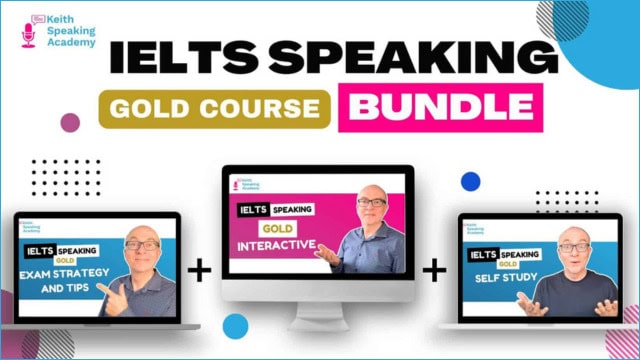
If you want to build your confidence in speaking like Olena, you can check out my course here:
More Student Success Stories
- Jason’s Story – See how Jason improved his IELTS Speaking score from Band 6.5 to Band 7.5 by reducing overthinking, practising consistently, and using structured speaking techniques.
- Stefanus’s Story – Learn how Stefanus improved his IELTS Speaking score from Band 4.5 to Band 6.5 through consistent practice, structured learning, and long-term commitment.