
👇 Take this lesson with you! 👇
The Speaking Success System
Learning English is an exciting journey, particularly when it comes to developing your speaking skills for your IELTS Speaking test.
Yet for many learners, vocabulary learning is one of the biggest challenges. Students often struggle to remember and use new words naturally in conversation.
But here’s the good news: improving your English speaking and vocabulary doesn’t have to be difficult.
I know, many English learners believe that learning vocabulary simply means memorising word lists, repeating phrases, or watching lots of English videos. While these methods can help, they only show part of the picture.
The truth is, learning and remembering vocabulary effectively is not a one-time effort — it’s a continuous process. That’s why I created a proven method called the Speaking Success System. This system lies at the heart of all my online English and IELTS Speaking courses, and it’s built around three essential steps:
👉 Discover – Practice – Review
Over the years, this simple but powerful cycle has helped thousands of students learn new words, speak more confidently, and finally stop forgetting what they learn.
Let’s look at how you can apply this system to learn English vocabulary effectively and build your IELTS Speaking confidence.
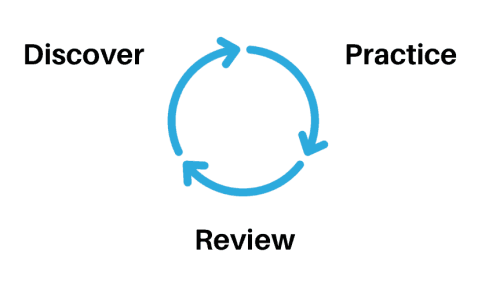
Table of Contents
A circle to learn vocabulary effectively
Many people think learning vocabulary is a linear process where you just keep learning new words and adding them to your notebook. They think it is similar to shopping.
So, when you learn vocabulary for a different topic, such as ‘sports’ or ‘clothes’, it’s like walking into a number of different shops, such as a sports shop or a clothes shop. When you learn a new word it’s like buying an item in that shop and putting it into your shopping bag.
However, this is not the way to learn vocabulary effectively. You will most likely forget most of those words, in the same way you forget about a lot of the items you have bought, after you put them in your wardrobe when you get home.
The problem is, even though you’ve accumulated these words, they’re still in your bag (or your notebook book) and not in your head.
You can’t access them or use them easily or correctly.
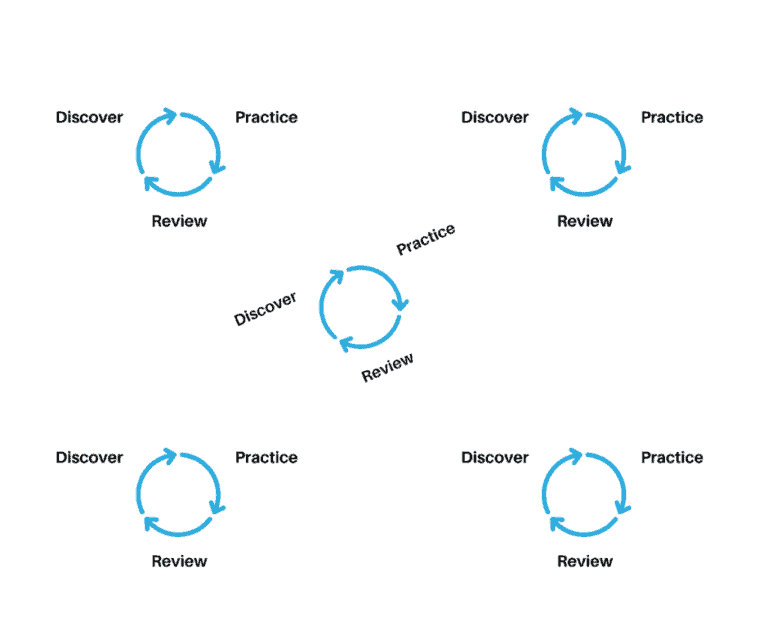
In fact, learning vocabulary is a circular process, not a straight line.
That process of discovering words, practicing and reviewing them is a circle, and you have lots of little circles moving, changing and even overlapping with each other, as you learn new vocabulary.
So, to learn vocabulary so you don’t forget it, you should follow these three steps:
- Discover
- Practice
- Review
Let’s look at each of these in detail.
#1. Discover new words in context
Discovery is the first step towards learning new vocabulary. It involves finding a new word, understanding its meaning, form, pronunciation, and how it’s used in context. To learn vocabulary effectively, you should aim to discover words in context, rather than just memorising word lists.
For instance, consider the word “shop.” You can learn its
- meaning (to buy things)
- word form (verb)
- pronunciation (/ʃɒp/)
- a chunk or collocation such as “shop around” (=to compare prices).
A good language leaner is like a detective; you need to first determine whether the word is essential and then investigate it.

#2. Practice vocabulary
Practicing is the stage where you actively use the new word. For example, once you’ve learned the basics about the word “shop” and its collocation “shop around,” you can practice using it in various ways.
I have a simple way to practise. It’s the way I teach in my IELTS Speaking GOLD online course
The great thing about this is you can do it on your own at home.
It involves changing one word in a sentence. Then repeating and repeating, changing a different word each time.
You can change nouns, tenses of verbs or even subjects and pronouns.
Here is an example, where I change first the noun twice, and then the tense, and finally the subject.
“I am shopping around for a new jumper”
“I am shopping around for a new car”
“I am shopping around for a new phone”
“I was shopping around for a new phone.”
“She was shopping around for a new phone.”
Finally, you can also invent your own sentences, saying something that is true for you.
“I hate shopping around, but my wife always shops around when we buy something new”
By practicing, you breathe life into the vocabulary, taking it out of your bag (or book) and placing it firmly in your mind.
👉 Learn more about how I use the Speaking Success System in the IELTS Speaking Gold course.

#3. Review vocabulary
Reviewing is the final step in this circular learning process. Here, you get feedback and deepen your understanding of the new vocabulary.
This feedback could come from a teacher or even other students.
It might also come from a real life experience using the new vocabulary. If you live in an English-speaking country and you go into a shop and say to the assistant,
“I am going to shop around your prices with other shops,”
When the assistant looks at you in a strange way, you may realise something is not quite right. This is direct feedback. When you ask what’s wrong, if you are lucky, they may explain and say you should say something like,
“I am going to shop around for better prices.”
Another way of getting feedback is by seeing or hearing the word used in different contexts. This is why I give my students mini-stories in the GOLD course, so they are exposed to the new vocabulary in a different context.
You learn words more deeply when you see them in different contexts. Each new context reinforces your understanding.This is why trying to continually expose yourself to the word in new contexts is essential, if you want to learn vocabulary effectively.
Conclusion
The cyclical methodology of Discover, Practice, and Review is an effective vocabulary-learning strategy that I incorporate into my GOLD online course.
This approach involves discovering new vocabulary via videos of IELTS Speaking model answers, practicing chunks with recorded videos, as well as in real-time breakout rooms with other students, and finally reviewing with quizzes and mini-stories.
Learning vocabulary is a long process, but it’s an enjoyable one. Embrace the journey, be patient, and foster a curiosity for language.
Remember, you’re not just learning words; you’re becoming a vocabulary detective!

Frequently Asked Questions
Memorizing words in isolation often leads to forgetting them. Effective vocabulary learning involves discovering words in context, practicing them actively, and reviewing them regularly to reinforce retention.
Discover new words by encountering them in context, such as through reading articles, listening to podcasts, or watching videos. Focus on understanding the word's meaning, pronunciation, and usage within the sentence.
Practise vocabulary by first repeating the word in the context you found it. Also try using new words in new sentences. Later, practise using just one or two new words in conversations, and even try writing out phrases from the conversation you had. Repetition and application in various contexts help solidify your understanding and usage.
Regularly review vocabulary by revisiting your notes, using spaced repetition techniques, and incorporating the words into your daily conversations. Use AI to create new articles and dialogues with the new vocabulary, so you see and hear it in new contexts. Engaging with the vocabulary in different contexts reinforces memory.
Improve your Speaking Skills with this Free Course
Crack IELTS Speaking Part 1
Learn to Speak with Confidence in Part 1 of Your IELTS Test!
⭐️⭐️⭐️⭐️⭐️
‘It’s such a great course. I’ve learned so many usages for speaking part 1.’
Zu Htet

9 thoughts on “How to Learn Vocabulary Effectively and Not Forget It”
no
yes no no yes yes yes yes no no no
Hie kith
I am l am studying English ,I need a better score in IELTS especially in writing.Atleast band 7 is oky. Can you please share the PDFs or books to help me.
Thank you.
shop also can be
a noun
I think that there is a lot things that I can learn of you. I’m extremely grateful for their help
oooooookkkkkkkkkkkkkk
Hi Keith,
I am an Iraqi medical doctor ,and I need high score in IELTs test band 7.
I am studying English now .I need to build good and new vocabulary.
Can you please share me your book as pdf “how to learn vocabulary Effectively and not Forget it”.
And, I would be highly appreciate your help, if you could please share all free lessons you have .I like your way in teaching.
Regards,
Shahad Khalil
[email protected]
Here is the link to the PDF you wanted, and you can find all the other free PDFs on the website. Good luck with your study. https://keithspeakingacademy.com/learn-vocabulary-effectively-pdf
Pingback: This is an effective way to learn vocabulary and not forget it - Meyild01