Table of Contents

How to Memorise and Remember English Vocabulary

👇 Take this lesson with you! 👇

Table of Contents

Have you ever spent an hour learning English vocabulary, only to forget it the next day?

The problem may not be your memory.

It may be how you are learning.

Reading a word and its meaning is only the first step. To remember vocabulary and use it when speaking, you need to:

  1. make the memory stronger
  2. make stronger connections
  3. review the vocabulary regularly

Let’s look at how this works.

Why do you forget new vocabulary?

Imagine you want to learn this expression:

deal with = handle or manage something

You read a few examples:

  • deal with a problem
  • deal with a difficult customer
  • deal with stress

You may understand the expression immediately. But understanding a word is not the same as remembering it.

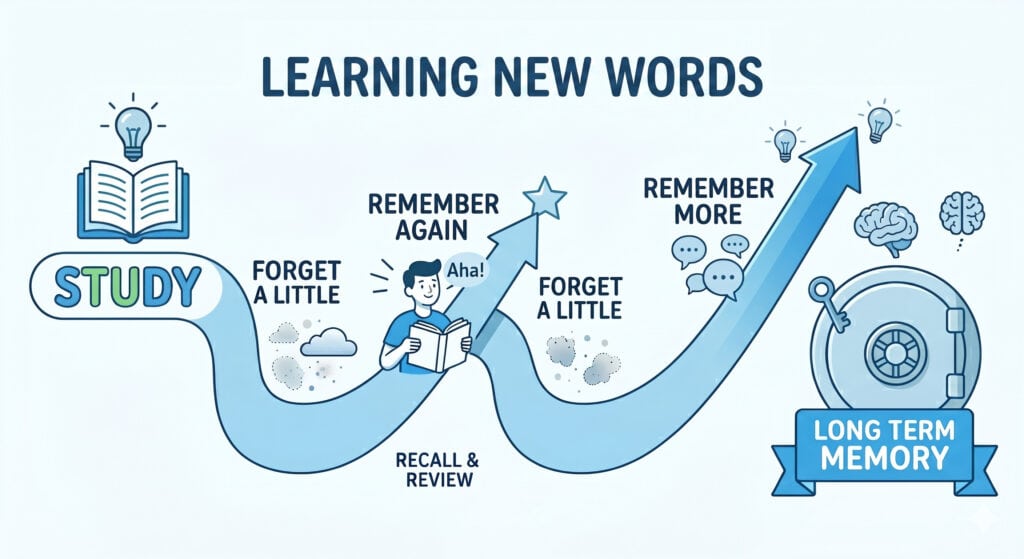
First, the word enters your short-term memory. Then you need to meet it and use it several times before it becomes part of your long-term memory.

The process often looks like this:

memory path

Forgetting is a normal part of learning. The important thing is to return to the vocabulary and practise recalling it.

#1. Make the memory stronger

Do not only read the word.

Try to:

  • See it
  • Hear it
  • Say it
  • Write it

See it in context

Look at this example

Stress Article

This paragraph shows you more than the meaning.

It shows you:

  • when the expression is used
  • how it works in a sentence
  • which words commonly appear with it

Instead of learning only deal with, you can learn the useful chunk:

‘To find it hard to deal with stress’

Hear it

Listen to someone saying the expression.

You can use an online dictionary, YouGlish, Google Translate or a video.

Notice the pronunciation, stress and rhythm.

Say it

Repeat the complete phrase:

  • deal with stress
  • deal with a problem
  • deal with a difficult customer

Then say the full sentence:

I find it hard to deal with stress.

Finally, look away and say it without reading.

Write it

Write one new example of your own:

Playing music helps me deal with stress.

Do not simply copy the original sentence. Change it and make it meaningful to you.

ielts students playing guitar

#2. Make stronger connections

Vocabulary is easier to remember when it is connected to other information.

Learn words together

For example, these expressions are all connected to work and stress:

  • deal with stress
  • be snowed under with work
  • work under pressure
  • have a heavy workload
  • meet a deadline
  • feel overwhelmed

Now put some of them into a short paragraph:

I have a heavy workload this week. I’m snowed under with work and I have to meet an important deadline. When I work under pressure, I sometimes find it hard to deal with stress.

This is more useful than memorising each expression separately. You can see how the language works together.

Connect new language to English you already know

Perhaps you already know:

To be snowed under with work

You can connect it to the new expression:

When I am snowed under with work, I find it hard to deal with stress.

The new expression is now connected to something already in your memory.

Make it personal

Compare these two examples:

Many doctors find it hard to deal with stress.

I find it hard to deal with stress when I have too much work.

The second sentence is more personal, so it may be easier to remember.

Try completing these sentences:

  • I find it difficult to deal with __________.
  • __________ helps me deal with stress.
  • When I am snowed under with work, I __________.

True examples are usually more memorable than random ones.

stress doctor

#3. Review the vocabulary regularly

Do not expect to remember a new word immediately. You need to meet it again.

However, reviewing does not mean simply reading the same page several times.

You need to test yourself.

Use the expression in different ways

You could,

  • read it in a short story
  • listen to it in a dialogue
  • use it in a conversation
  • write a personal example
  • put it on a flashcard

For example, you could create a short story using:

  • deal with stress
  • be snowed under with work
  • meet a deadline
  • feel overwhelmed

Later, try to retell the story without looking at it.

Use spaced repetition

Review the expression several times over a longer period.

For example,

  • later today
  • tomorrow
  • in three days

Each time, try to remember the expression before checking your notes.

Practise active recall

Active recall means trying to remember the answer yourself.

Instead of reading:

deal with = handle or manage something

Ask yourself; “What expression means to handle or manage a difficult situation?”

You can also test yourself with flashcards or by preparing prompts such as:

  • Complete the phrase: deal ___ stress.
  • Name three things people commonly deal with.
  • Use deal with stress in a true sentence.
  • Complete this sentence: When I am snowed under with work…

This is much more effective than simply re-reading.

A simple vocabulary routine

Here is a practical routine you can use for new vocabulary.

Day 1

  • Find a complete example.
  • Check the meaning.
  • Listen to it.
  • Say it aloud.
  • Write a personal sentence.
  • Connect it to related vocabulary.

Day 2

Day 3

  • Test the meaning.
  • Make some phrases about you with this vocabulary
  • Use the expression while speaking.

Remember these three steps

1. Make the memory stronger

See it. Hear it. Say it. Write it.

2. Make stronger connections

Learn it in context. Connect it to other English. Make it personal.

3. Review it regularly

Meet it again. Test yourself. Practise recall.

The goal is not to learn the largest possible number of words.

The goal is to remember useful vocabulary and use it confidently.

memorise.

Download the free vocabulary workbook

The free workbook will help you put this method into practice.

You can use it to:

  • choose useful expressions
  • create personal examples
  • plan your reviews
  • test your memory
  • practise active recall

FAQs

Learn vocabulary in context, listen to it, say it, write a personal example and review it through active recall over several days or weeks.

Start with three to five useful words or expressions. It is better to learn a small number properly than to study a long list that you quickly forget.

Recognising a word is easier than recalling it. It may take weeks to pass a word into your long-term memory and so be able to use it easily in conversation. To improve recall, close your notes and practise completing sentences, answering questions and speaking with the new vocabulary.

Yes, but only when you try to recall the answer before turning the card over. Include a useful phrase or sentence, not only a translation.

Download the free vocabulary workbook here.

Picture of Keith O'Hare

Keith O'Hare

Keith O’Hare, English teacher and founder of Keith Speaking Academy. Trinity Diploma in TESOL and an MSc in Digital Education (UK). Over 40,000 learners have taken his online courses.

Leave a Comment

Your email address will not be published. Required fields are marked *

Get your pdf now!

Use Grammar Fluently!

✓ Activate your grammar 

✓ Improve your accuracy

✓ Get native-like intonation

Fluent Grammar for IELTS Speaking